
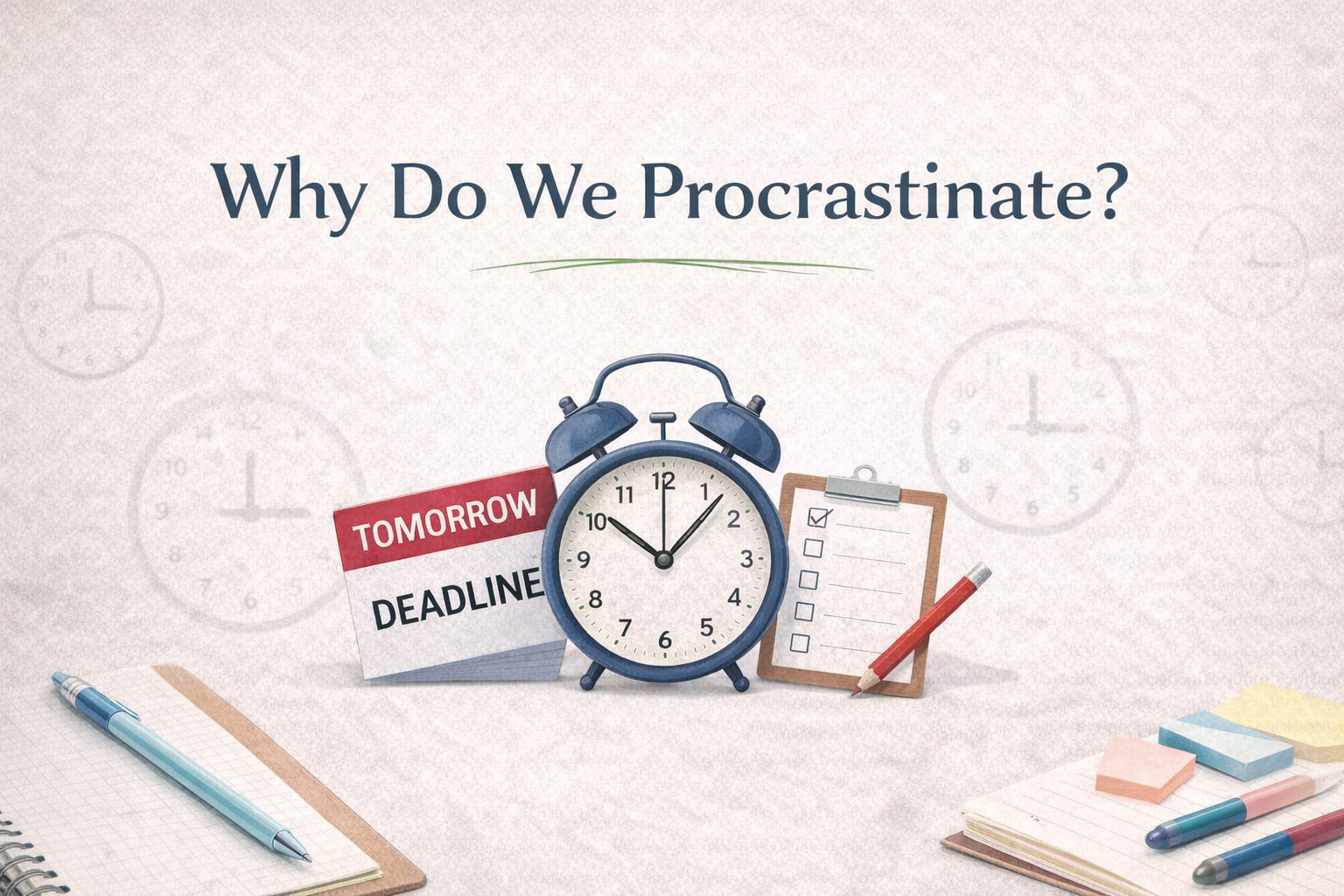
Why do we procrastinate?
Procrastination, or the art of putting off until tomorrow what you should really be getting on with today, is common amongst people of all ages. However, it is particularly problematic amongst students. Around a fifth of adults (0) ________, but among students the figure is closer to 90%. Some insist that they work better when they are up against a tight deadline, but research carried out by a leading psychologist shows that those who procrastinate most are likely to suffer in the long term from low mood, to experiencing more health problems and failing to manage their finances properly. In addition, procrastinators (Q1) ________. They also miss out on chances to have fun by waiting too long to book concert or flight tickets, or to organise social events.
There are several different ways to look at procrastination. One is to link it to certain personality traits. People who are highly conscientious are less likely to procrastinate because they (Q2) ________ and are persistent and dutiful. On the other hand those who are impulsive are more likely to procrastinate. They are easily distracted and find it difficult to settle to a task unless there’s a real sense of urgency about it. Personality traits (Q3) ________. The nature of the task at hand also has a bearing. No matter what kind of person you are, you will give less importance to a task that is far in the future than to one that is in front of you today. In addition, humans are naturally pleasure-seeking and so, unsurprisingly, often delay tackling unpleasant tasks.
So far, so obvious, you may be thinking. But there are other, deeper and more interesting causes for procrastination. One such comes under the category of self-handicapping. This unconscious strategy allows people to (Q4) ________, but have an excuse for any failure. For example, imagine you have a difficult task to achieve. Thinking rationally, you would get on with the task in good time and finish it to the best of your abilities.
If things don’t work out, you know that at least you gave it your best shot. If, however, you take the self-handicapping approach, you (Q5) ________. Doing this almost guarantees that you will fail, but gives you an excuse – “I ran out of time!” By doing this you have avoided having to admit to a lack of ability, and your sense of self-worth is preserved.
Yet another factor involved in procrastination is the sense of danger that people experience when they are at risk of missing an important deadline. This seems to (Q6) ________, who tend to be task-oriented rather than thrill-seeking. For some extroverts, the adrenaline rush that accompanies near failure is felt to be essential in propelling them to produce their best work.
For introverts, and particularly perfectionists, fear of making mistakes may lead to procrastination, or at least to delays in completing and handing in assignments. It is ironic that wanting to get things just right could lead to penalties for lateness and (Q7) ________ that they are no different from less conscientious individuals who hand work in late for very different reasons.
Unfortunately, the urge to procrastinate is so deeply embedded in the human psyche that it is not realistic to expect to be able to avoid it completely. However, by analysing what lies behind your own procrastination, you may be able to (Q8) ________ that will help you get on with tasks in a timelier manner.
📝 COMPREHENSION QUESTIONS
📌 General understanding
- What is procrastination?
- Why is it especially common among students?
- What negative effects can procrastination have?
📌 Details
- What personality types are less likely to procrastinate?
- Why do impulsive people procrastinate more?
- What is “self-handicapping”?
📌 Interpretation
- Why do some people work better under pressure?
- How can fear influence procrastination?
🎤 MÜNDLICHE PRÜFUNG (AHS / Matura Stil)
🧠 Teil 1: Describe the text
👉 Example answer:
“The text explains why people procrastinate and what psychological factors are behind it. It describes personality traits, emotional reasons and the concept of self-handicapping.”
💬 Teil 2: Main ideas
Possible questions:
- What are the main causes of procrastination?
- What is self-handicapping?
🧍 Teil 3: Personal opinion
👉 Questions:
- Do you procrastinate? Why?
- Is procrastination always negative?
- Do you work better under pressure?
👉 Example answer:
“In my opinion, procrastination can sometimes help because pressure can increase motivation. However, in the long term it can be harmful.”
🧩 Teil 4: Discussion
- How can students avoid procrastination?
- What strategies can help?
👉 Ideas:
- planning
- small goals
- time management
- avoiding distractions
🎯 EXTRA FORMULIERUNGSHILFEN
- “The text deals with…”
- “One important point is…”
- “Another reason is…”
- “In my opinion…”
- “To sum up…”
📖 Why do we procrastinate? (Completed Text)
Why do we procrastinate?
Procrastination, or the art of putting off until tomorrow what you should really be getting on with today, is common amongst people of all ages. However, it is particularly problematic amongst students. Around a fifth of adults (0) procrastinate regularly, but among students the figure is closer to 90%. Some insist that they work better when they are up against a tight deadline, but research carried out by a leading psychologist shows that those who procrastinate most are likely to suffer in the long term from low mood, to experiencing more health problems and failing to manage their finances properly. In addition, procrastinators (Q1) often delay important tasks. They also miss out on chances to have fun by waiting too long to book concert or flight tickets, or to organise social events.
There are several different ways to look at procrastination. One is to link it to certain personality traits. People who are highly conscientious are less likely to procrastinate because they (Q2) are well-organised and are persistent and dutiful. On the other hand those who are impulsive are more likely to procrastinate. They are easily distracted and find it difficult to settle to a task unless there’s a real sense of urgency about it. Personality traits (Q3) play an important role. The nature of the task at hand also has a bearing. No matter what kind of person you are, you will give less importance to a task that is far in the future than to one that is in front of you today. In addition, humans are naturally pleasure-seeking and so, unsurprisingly, often delay tackling unpleasant tasks.
So far, so obvious, you may be thinking. But there are other, deeper and more interesting causes for procrastination. One such comes under the category of self-handicapping. This unconscious strategy allows people to (Q4) avoid doing the task properly, but have an excuse for any failure. For example, imagine you have a difficult task to achieve. Thinking rationally, you would get on with the task in good time and finish it to the best of your abilities.
If things don’t work out, you know that at least you gave it your best shot. If, however, you take the self-handicapping approach, you (Q5) leave the task until the last minute. Doing this almost guarantees that you will fail, but gives you an excuse – “I ran out of time!” By doing this you have avoided having to admit to a lack of ability, and your sense of self-worth is preserved.
Yet another factor involved in procrastination is the sense of danger that people experience when they are at risk of missing an important deadline. This seems to (Q6) apply to introverts, who tend to be task-oriented rather than thrill-seeking. For some extroverts, the adrenaline rush that accompanies near failure is felt to be essential in propelling them to produce their best work.
For introverts, and particularly perfectionists, fear of making mistakes may lead to procrastination, or at least to delays in completing and handing in assignments. It is ironic that wanting to get things just right could lead to penalties for lateness and (Q7) give the impression that they are no different from less conscientious individuals who hand work in late for very different reasons.
Unfortunately, the urge to procrastinate is so deeply embedded in the human psyche that it is not realistic to expect to be able to avoid it completely. However, by analysing what lies behind your own procrastination, you may be able to (Q8) find strategies that will help you get on with tasks in a timelier manner.
Schreibe einen Kommentar