
Theory, Explanation, Examples, Exercises & Separate Solutions
By MMag. Karin Silvina Hiebaum
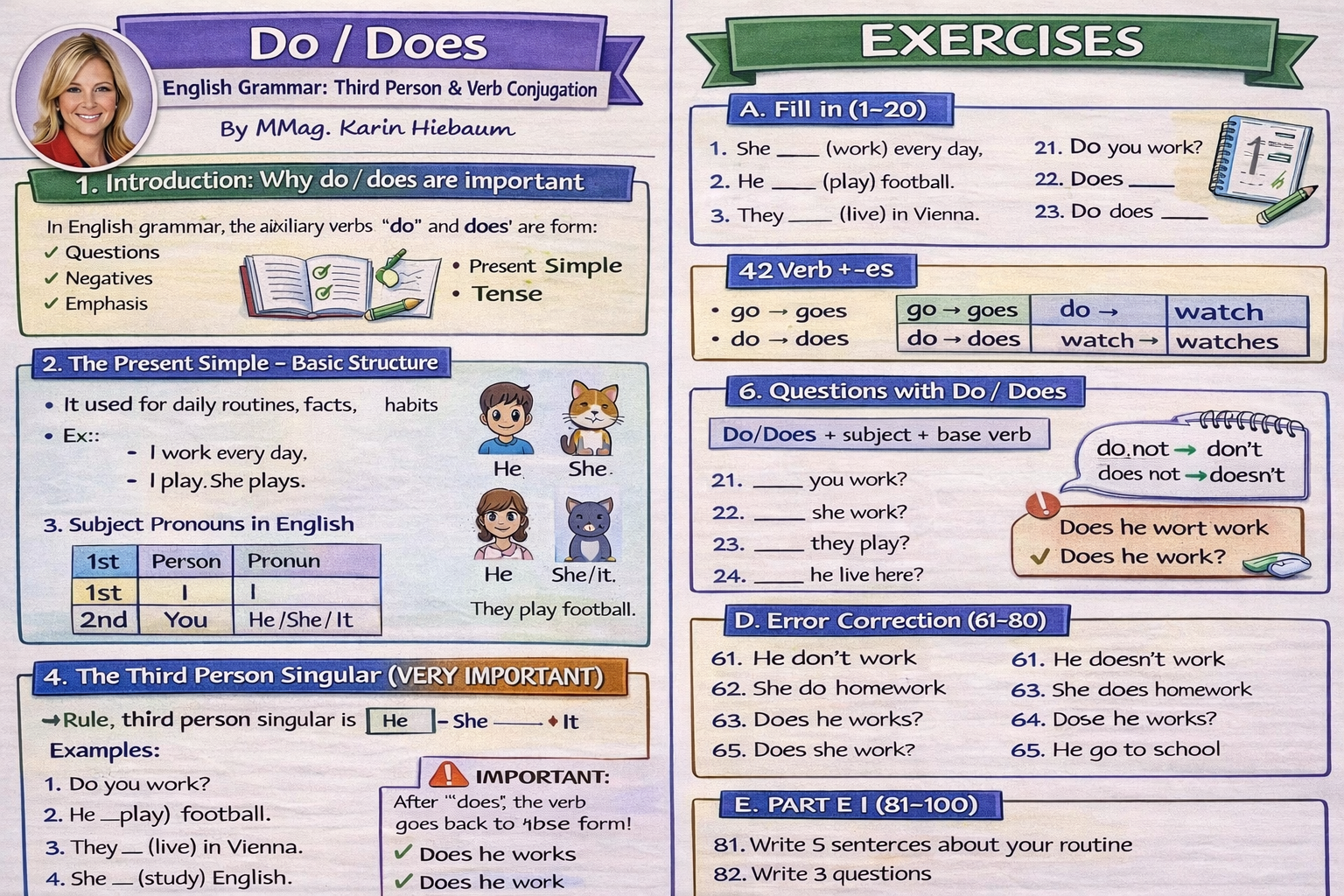
🧾 1. Introduction: Why “do” and “does” are important
In English grammar, the auxiliary verbs “do” and “does” are fundamental. They are used to form:
- Questions
- Negatives
- Emphasis
Understanding how to use “do” and “does” correctly is essential for building correct sentences, especially in the Present Simple tense.
Many students find this topic confusing, especially when dealing with the third person singular (he, she, it). This paper will explain the rules step by step with clear examples and structured exercises.
📊 2. The Present Simple – Basic Structure
Before learning “do” and “does”, we need to understand the Present Simple tense.
👉 It is used for:
- Daily routines
- Facts
- habits
Examples:
- I work every day.
- She lives in Vienna.
- They play football.
👤 3. Subject Pronouns in English
| Person | Pronoun |
|---|---|
| 1st | I |
| 2nd | You |
| 3rd | He / She / It |
| Plural | We / You / They |
⭐ 4. The Third Person Singular (VERY IMPORTANT)
👉 The third person singular is:
- He
- She
- It
Rule:
👉 The verb changes!
🔹 4.1 Verb + “-s”
- I work → He works
- I play → She plays
🔹 4.2 Verb + “-es”
Used with:
- go → goes
- do → does
- watch → watches
🔹 4.3 Special cases
- study → studies
- try → tries
👉 Rule: consonant + y → ies
⚙️ 5. “Do” and “Does” – Basic Rule
| Subject | Auxiliary |
|---|---|
| I / You / We / They | do |
| He / She / It | does |
❓ 6. Questions with Do / Does
👉 Structure:
Do/Does + subject + base verb
Examples:
- Do you work?
- Do they play football?
- Does he work?
- Does she live here?
⚠️ IMPORTANT:
👉 After “does”, the verb goes back to base form!
❌ Does he works
✔️ Does he work
🚫 7. Negatives with Do / Does
👉 Structure:
Subject + do/does + not + verb
Examples:
- I do not work.
- You do not understand.
- He does not work.
- She does not like coffee.
Short forms:
- do not → don’t
- does not → doesn’t
🔁 8. Affirmative vs Negative vs Question
| Type | Example |
|---|---|
| Affirmative | She works |
| Negative | She does not work |
| Question | Does she work? |
🧠 9. Common Mistakes
❌ He don’t work
✔️ He doesn’t work
❌ Does she works?
✔️ Does she work?
❌ She do her homework
✔️ She does her homework
🧾 10. Conjugation Overview
Verb: TO WORK
| Subject | Verb |
|---|---|
| I | work |
| You | work |
| He/She/It | works |
| We | work |
| They | work |
🎯 11. Use of “Do” as a Main Verb
“Do” can also be a main verb:
- I do my homework.
- She does her homework.
✏️ 12. Exercises
🔹 PART A – Fill in (1–20)
- She ___ (work) every day.
- He ___ (play) football.
- They ___ (live) in Vienna.
- She ___ (study) English.
- He ___ (go) to school.
- I ___ (like) coffee.
- She ___ (like) tea.
- He ___ (watch) TV.
- They ___ (watch) movies.
- It ___ (rain).
- She ___ (try).
- He ___ (fix).
- She ___ (teach).
- He ___ (do) homework.
- It ___ (fly).
- We ___ (work).
- She ___ (work).
- He ___ (study).
- They ___ (study).
- It ___ (play).
🔹 PART B – Questions (21–40)
- ___ you work?
- ___ she work?
- ___ they play?
- ___ he live here?
- ___ she like coffee?
- ___ they go to school?
- ___ he study English?
- ___ she watch TV?
- ___ it rain?
- ___ you understand?
31–40: Form questions
🔹 PART C – Negatives (41–60)
- She works → negative
- He plays → negative
- They live → negative
- She studies → negative
- He watches TV → negative
46–60: same pattern
🔹 PART D – Error Correction (61–80)
- He don’t work
- She do homework
- Does he works?
- She don’t like tea
- He go to school
66–80: correct sentences
🔹 PART E – Writing (81–100)
- Write 5 sentences about your routine
- Write 3 questions
- Write 3 negatives
- Describe a person
85–100: free writing
✅ SOLUTIONS (SEPARATE)
✔️ PART A
- works
- plays
- live
- studies
- goes
- like
- likes
- watches
- watch
- rains
- tries
- fixes
- teaches
- does
- flies
- work
- works
- studies
- study
- plays
✔️ PART B
- Do
- Does
- Do
- Does
- Does
✔️ PART C
- She does not work
- He does not play
- They do not live
- She does not study
- He does not watch TV
✔️ PART D
- He doesn’t work
- She does homework
- Does he work?
- She doesn’t like tea
- He goes to school
✔️ PART E
👉 individuelle Antworten (correct structure required)
🎯 Conclusion
Understanding “do” and “does” is essential for mastering English grammar. Once students understand:
- third person rules
- question structure
- negatives
they gain confidence in speaking and writing.
📘 Modal Verbs in English – Complete Explanation
(can, could, must, have to, should, may, might, will, would)
By MMag. Karin Silvina Hiebaum
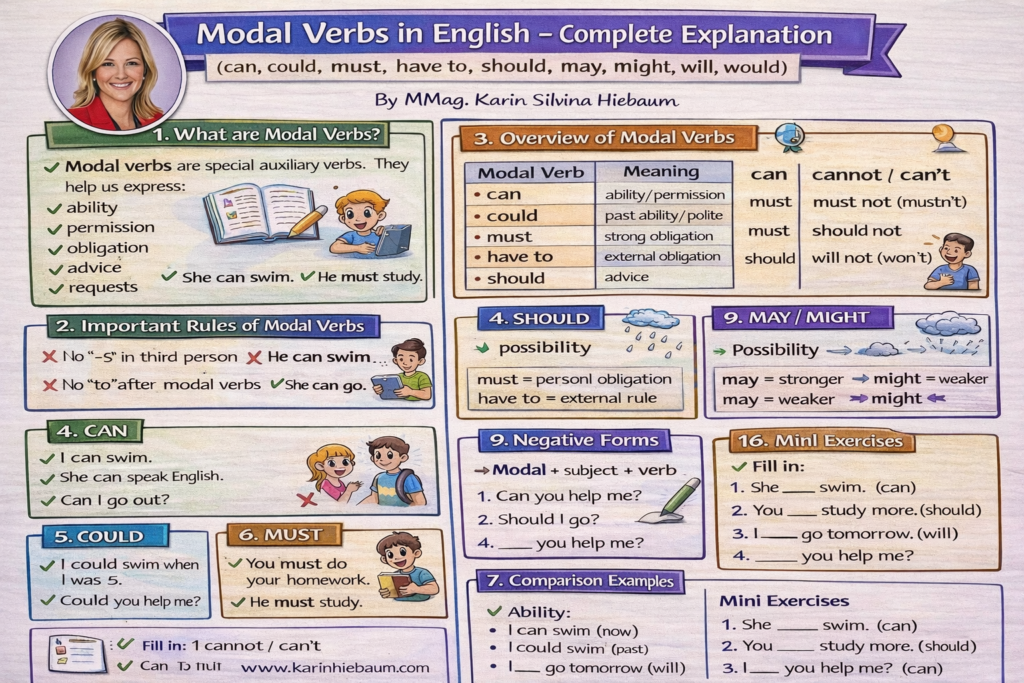
🧾 1. What are Modal Verbs?
Modal verbs are special auxiliary verbs.
They help us express:
- ability
- permission
- obligation
- advice
- possibility
- requests
👉 They are always followed by a base verb (infinitive without “to”)
✔️ Example:
- She can swim.
- He must study.
⚙️ 2. Important Rules of Modal Verbs
🔹 Rule 1: No “-s” in third person
❌ He cans swim
✔️ He can swim
🔹 Rule 2: No “to” after modal verbs
❌ She can to go
✔️ She can go
🔹 Rule 3: No “do/does” needed
❌ Do you can swim?
✔️ Can you swim?
🔹 Rule 4: Same form for all persons
I can / you can / he can / they can
📊 3. Overview of Modal Verbs
| Modal Verb | Meaning |
|---|---|
| can | ability / permission |
| could | past ability / polite |
| must | strong obligation |
| have to | external obligation |
| should | advice |
| may | permission (formal) |
| might | possibility |
| will | future |
| would | polite / conditional |
💪 4. CAN
👉 Meaning:
- ability
- permission
Examples:
- I can swim.
- She can speak English.
- Can I go out?
⏳ 5. COULD
👉 Meaning:
- past ability
- polite request
Examples:
- I could swim when I was 5.
- Could you help me?
⚠️ 6. MUST
👉 Meaning:
- strong obligation
- necessity
Examples:
- You must do your homework.
- He must study.
🔄 7. HAVE TO
👉 Meaning:
- obligation (external rules)
Examples:
- I have to go to school.
- She has to work.
👉 Difference:
- must = personal obligation
- have to = external rule
💡 8. SHOULD
👉 Meaning:
- advice
- recommendation
Examples:
- You should sleep more.
- He should study.
🌟 9. MAY / MIGHT
👉 Meaning:
- possibility
Examples:
- It may rain.
- She might come later.
👉 may = stronger possibility
👉 might = weaker possibility
🔮 10. WILL
👉 Meaning:
- future
- decisions
Examples:
- I will go tomorrow.
- She will call you.
🤝 11. WOULD
👉 Meaning:
- polite requests
- hypothetical situations
Examples:
- Would you help me?
- I would go if I had time.
🔄 12. Negative Forms
| Modal | Negative |
|---|---|
| can | cannot / can’t |
| must | must not (mustn’t) |
| should | should not |
| will | will not (won’t) |
Examples:
- I can’t swim.
- You mustn’t smoke.
- She shouldn’t go.
❓ 13. Questions with Modal Verbs
👉 Structure:
Modal + subject + verb
Examples:
- Can you help me?
- Should I go?
- Will she come?
⚠️ 14. Common Mistakes
❌ He can swims
✔️ He can swim
❌ She must to go
✔️ She must go
❌ Do you can help?
✔️ Can you help?
🧠 15. Comparison Examples
Ability:
- I can swim (now)
- I could swim (past)
Obligation:
- I must study (personal)
- I have to study (rule)
Advice:
- You should sleep more
Possibility:
- It may rain
- It might rain
✏️ 16. Mini Exercises
Fill in:
- She ___ swim. (can)
- You ___ study more. (should)
- I ___ go tomorrow. (will)
- ___ you help me? (can)
- He ___ work. (must)
✅ Solutions
- can
- should
- will
- Can
- must
🎯 17. Summary (Very Important for Students)
✔ Modal verbs are always followed by base form
✔ No “-s” in third person
✔ No “to” after modal verbs
✔ No “do/does”
💬 18. Final Conclusion
Modal verbs are essential for communication in English. They allow students to express not only actions, but also attitudes such as obligation, possibility, and advice.
👉 Mastering modal verbs helps students:
- speak more naturally
- understand real conversations
- build correct sentences
Schreibe einen Kommentar